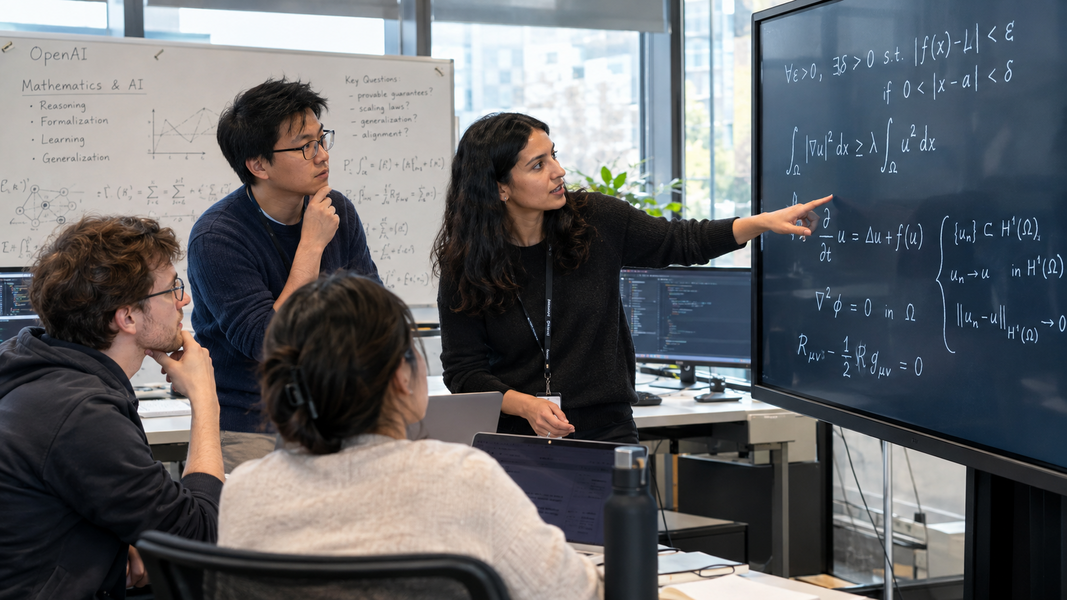
Recently, OpenAI has unveiled a series of groundbreaking mathematical proofs that could have significant implications for the future of artificial intelligence (AI). This development showcases the organization’s ongoing commitment to advancements in the field and highlights how AI is increasingly intersecting with complex problem-solving in mathematics.
What are the New Math Proofs?
The math proofs published by OpenAI address several unsolved problems in mathematical theory. While specific details of these proofs are still under review, the initiative marks a pivotal moment in AI capabilities, demonstrating that AI systems can contribute meaningfully to traditionally complex and human-centric fields like mathematics.
The Significance of OpenAI’s Achievements
The release of these proofs is notable for several reasons:
- AI Advancements: This achievement highlights the advancements in AI, showing that these systems can now tackle problems that were once thought to be in the exclusive domain of human mathematicians.
- Solving Unsolved Problems: By focusing on unsolved math problems, OpenAI is pushing the boundaries of what AI can achieve, potentially paving the way for innovative solutions to longstanding mathematical challenges.
- Cross-Industry Implications: The ability to produce valid mathematical proofs could have far-reaching effects on various industries that rely on mathematical modeling, algorithms, and data analysis. This could be particularly relevant for sectors such as finance, engineering, and scientific research.
What Do We Know So Far?
OpenAI’s latest achievement is positioned within a broader context of technological evolution. As AI continues to mature, the findings suggest that further integration of AI systems in significant problem-solving roles may become commonplace in the near future. While the precise applications of these proofs are still being assessed, they present a fascinating opportunity for collaboration between mathematics and AI technology.
What Readers Should Know
It’s essential for those interested in technology and its implications to stay updated with OpenAI’s ongoing research. The release of these proofs not only signifies a leap in AI’s ability to assist in complex problem-solving but also raises questions about the future roles of AI in fields traditionally performed by specialists.
Conclusion
OpenAI’s publication of new math proofs represents a remarkable milestone in AI advancements. By addressing unsolved problems in mathematics, the organization is not only advancing the field of AI but also potentially transforming how industries approach mathematical challenges. As more information becomes available, the implications of these developments will become clearer, further bridging the gap between human intellect and artificial reasoning.